
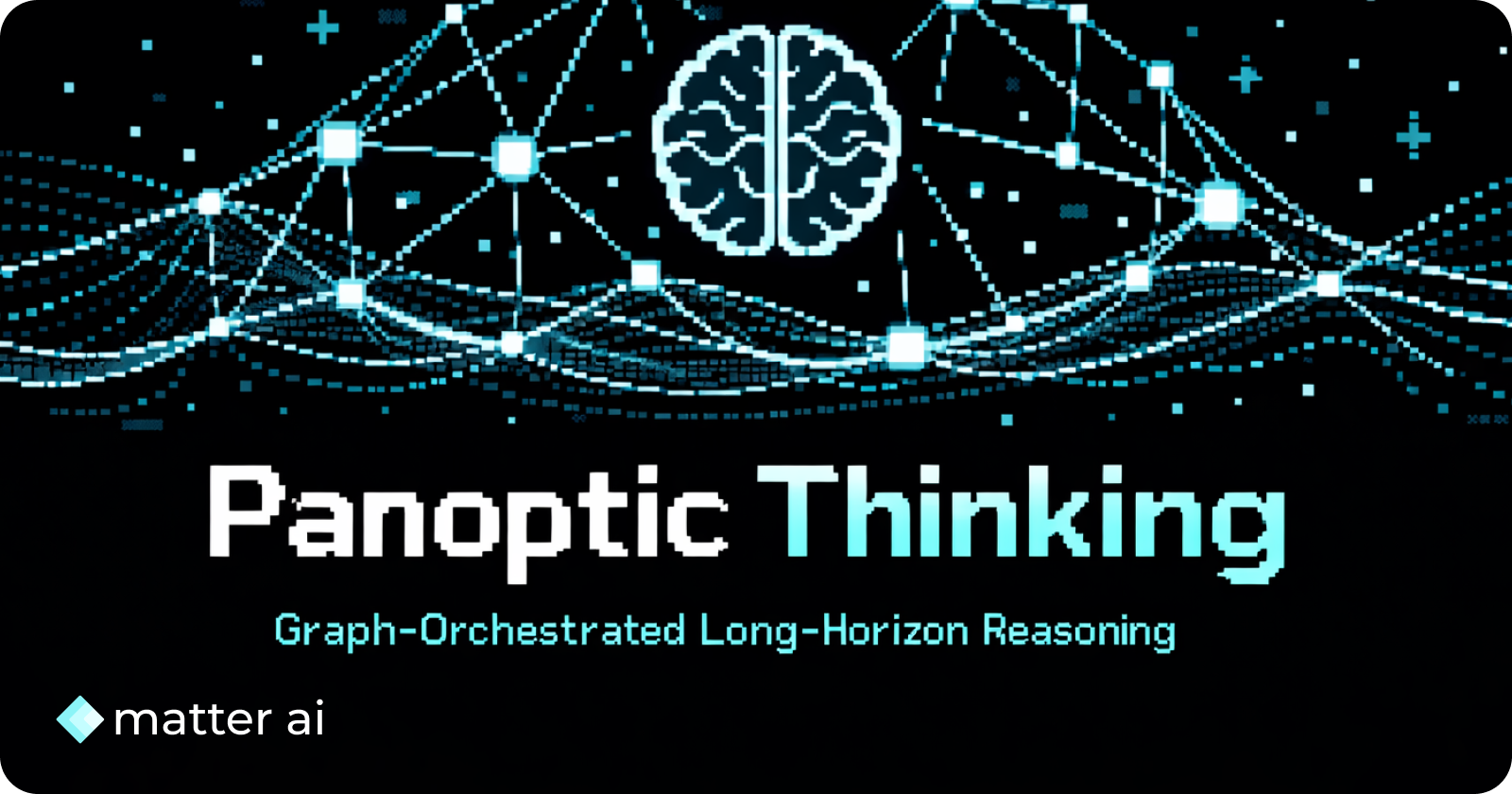
Panoptic Thinking

Panoptic Thinking: A Graph-Orchestrated Global Reasoning Architecture for Long-Horizon Autonomous Systems
Author: Vatsal Bajpai
Affiliation: Independent Research
Abstract
Large language models (LLMs) exhibit strong local reasoning but degrade in long-horizon, multi-step environments due to bounded attention windows, sequential drift, and lack of structural state persistence. We introduce Panoptic Thinking, a graph-orchestrated global reasoning architecture that transforms stepwise inference into structured execution cognition.
Unlike linear chain-of-thought reasoning, Panoptic Thinking maintains a continuously updated Global Execution Graph, integrates an Internal Q/A Map, performs global plan re-synthesis before every action, and explicitly separates reasoning artifacts from execution artifacts. The architecture corrects attention-window constraints by externalizing cognition into structured state representations and injecting compressed global summaries into each decision cycle.
This paper formalizes the architecture, defines its algorithmic structure, analyzes computational properties, and situates it relative to prior work in attention mechanisms, memory-augmented networks, retrieval systems, and planning-based agents.
1. Introduction
Transformer-based models rely on self-attention over fixed token windows (Vaswani et al., 2017). Despite scaling advances (Brown et al., 2020), bounded context introduces structural limitations:
- Constraint forgetting
- Plan drift
- Myopic optimization
- Cascading execution errors
Chain-of-Thought (CoT) prompting improves reasoning by exposing intermediate steps (Wei et al., 2022; Kojima et al., 2022). However:
- It remains linear
- It does not maintain persistent structural state
- It does not support global retroactive re-optimization
Modern agent architectures (Yao et al., 2022) interleave reasoning and acting but still rely on sequential context accumulation.
Panoptic Thinking replaces linear reasoning with graph-orchestrated execution cognition, enabling:
- Global state persistence
- Continuous plan correction
- Structured constraint propagation
- Attention-window independence
2. Problem Formulation
Let:
- = token history at time
- = attention window size
- truncation
Standard sequential reasoning:
Information outside the window becomes inaccessible.
Panoptic Thinking defines:
Where:
- = persistent Global Execution Graph
- = global planning policy
- Decisions are conditioned on structured state, not raw token history
3. Architectural Overview
Panoptic Thinking consists of five coordinated components:
- Execution Graph Builder
- Internal Q/A Map
- Global Evaluator
- Recursive Planner
- Execution Plan Synthesizer
4. Global Execution Graph
The system constructs a directed acyclic graph (DAG).
4.1 Node Types
- Reasoning nodes
- Action nodes
- Tool decision nodes
- Constraint nodes
- Evaluation nodes
- Strategy nodes
Each node stores:
{
  "id": "node_id",
  "type": "reasoning | action | constraint | evaluation",
  "input_state": {},
  "output_state": {},
  "dependencies": [],
  "constraints": [],
  "score": 0.0,
  "metadata": {}
}
4.2 Edge Semantics
Edges encode:
- Causal dependency
- Logical dependency
- Constraint propagation
- Plan membership
The graph persists independently of token context.
5. Internal Q/A Map
A defining property of Panoptic Thinking is the Internal Q/A Map.
Instead of implicit reasoning, the system explicitly generates:
- Internal Questions (Q)
- Internal Answers (A)
- Tool Decisions
- Strategy Declarations
Example structure:
{
  "intent": "MODIFY",
  "target": "...",
  "constraints": [],
  "missing_info": [],
  "internal_questions": [],
  "internal_answers": [],
  "tool_decisions": [],
  "strategy": []
}
This Q/A map becomes a structured reasoning artifact stored in the graph.
It enables:
- Explicit uncertainty tracking
- Missing-information detection
- Deterministic tool selection
- Structured strategy evolution
6. Execution Plan Synthesis
Panoptic Thinking separates reasoning from execution.
6.1 Execution Plan Object
Before each action:
{
  "global_summary": "...",
  "active_constraints": [],
  "conflicts_detected": [],
  "tool_decision": "...",
  "strategy": [],
  "execution_plan": [
    { "step": 1, "action": "...", "condition": "..." },
    { "step": 2, "action": "...", "condition": "..." }
  ],
  "next_action": "..."
}
6.2 Key Property
The system does not execute based on immediate prior tokens.
It executes based on:
- Structured global state
- Validated constraints
- Synthesized plan
7. Attention Window Correction
Panoptic Thinking corrects bounded attention via structural externalization.
7.1 Structural Persistence
All reasoning artifacts persist in . Nothing is lost due to token truncation.
7.2 Compression Instead of Truncation
Inactive subgraphs are summarized:
Compression preserves:
- Constraints
- Plan invariants
- Conflict markers
- Active goals
7.3 Constraint Rehydration
Before each decision:
- Extract active constraints
- Detect contradictions
- Reinject necessary state abstractions
This parallels constraint propagation methods in symbolic AI (Russell & Norvig, 2020).
7.4 Global Re-Synthesis
Instead of greedy continuation:
Plans are recomputed at every iteration.
8. Algorithm
Initialize G

while not terminal:
    observe environment
    update G
    update internal Q/A map
    evaluate consistency
    compress inactive subgraphs
    synthesize execution_plan
    select next_action
    execute
9. Comparative Analysis
| Paradigm | Linear | Persistent Structure | Global Replanning |
|---|---|---|---|
| CoT (Wei et al., 2022) | Yes | No | No |
| Zero-Shot CoT (Kojima et al., 2022) | Yes | No | No |
| RAG (Lewis et al., 2020) | Yes | Partial | No |
| Neural Turing Machines (Graves et al., 2016) | No | Yes | No |
| ReAct (Yao et al., 2022) | Yes | Partial | Limited |
| Panoptic Thinking | No | Yes | Yes |
Panoptic Thinking uniquely integrates:
- Structured global memory
- Internal Q/A orchestration
- Tool decision governance
- Continuous plan rewriting
10. Theoretical Properties
10.1 Non-Local Reasoning
Graph-based instead of linear trace reasoning.
10.2 Controlled Forgetting
Relevance-based pruning replaces token decay.
10.3 Deterministic Constraint Preservation
Constraints are structural objects, not implicit tokens.
10.4 Long-Horizon Stability
Performance degradation grows sublinearly relative to context-bound systems.
11. Computational Complexity
Naive evaluation:
Optimizations:
- Hierarchical graph abstraction
- Lazy subgraph expansion
- Embedding clustering (Lewis et al., 2020)
- Selective constraint propagation
Empirically tractable for multi-step execution tasks.
12. Limitations
- Increased orchestration overhead
- Graph management complexity
- Requires disciplined summarization
- Potential over-optimization loops
13. Conclusion
Panoptic Thinking converts attention-bounded sequence models into structurally persistent reasoning systems.
It introduces:
- Global Execution Graphs
- Internal Q/A Maps
- Execution Plan Synthesis
- Continuous Global Re-Optimization
It does not extend the attention window.
It makes the window irrelevant.
References
Brown, T. et al. (2020). Language Models are Few-Shot Learners. NeurIPS.
Graves, A., Wayne, G., & Danihelka, I. (2016). Neural Turing Machines. Nature.
Kojima, T. et al. (2022). Large Language Models are Zero-Shot Reasoners. NeurIPS.
Lewis, P. et al. (2020). Retrieval-Augmented Generation for Knowledge-Intensive NLP Tasks. NeurIPS.
Russell, S., & Norvig, P. (2020). Artificial Intelligence: A Modern Approach (4th ed.). Pearson.
Vaswani, A. et al. (2017). Attention Is All You Need. NeurIPS.
Wei, J. et al. (2022). Chain-of-Thought Prompting Elicits Reasoning in Large Language Models. NeurIPS.
Yao, S. et al. (2022). ReAct: Synergizing Reasoning and Acting in Language Models. arXiv.
MatterAI builds frontier AI infrastructure for engineering teams — from inference-optimized models to autonomous coding agents and agentic code reviews.
Explore what we're building:
- Orbital IDE — Autonomous AI coding agent with background agents and deep codebase memory
- AI Code Reviews — Agentic pre-commit reviews across GitHub, GitLab, and Bitbucket
- Axon Models — Frontier-grade reasoning models at 70% lower inference cost
Share this Article:
More Articles
DSpark Speculative Decoding: How It Works & Speeds Up LLM Inference
Learn how DSpark speculative decoding accelerates LLM inference by 60–85% using semi-autoregressive drafting and confidence-scheduled verification.
Top 5 CLI Coding Agents in 2026: A Comprehensive Comparison
A deep dive into the top 5 CLI coding agents of 2026: OrbCode, Claude Code, Codex CLI, OpenCode, and Grok Build. Compare pros, cons, pricing, models, and wins to find the best fit for your workflow.
Data Annealing: The Hidden Optimization Layer Behind Modern AI Systems
Modern AI systems are no longer trained on static datasets. Frontier models continuously reshape, refine, replay, and optimize data throughout training — creating a new paradigm we call Data Annealing.
The Economics of AI Agents: How Companies Are Reducing AI Inference Costs by 70%
AI agents are becoming core infrastructure inside modern companies, but inference costs are scaling faster than most teams expect. Here's why AI agents become expensive — and how organizations are reducing operational AI costs by up to 70%.
How We Rebuilt the Context Layer Behind AI Code Review
Let's dive deep into the most advance and cost effective code reviewer
Continue Reading
DSpark Speculative Decoding: How It Works & Speeds Up LLM Inference
Learn how DSpark speculative decoding accelerates LLM inference by 60–85% using semi-autoregressive drafting and confidence-scheduled verification.
Top 5 CLI Coding Agents in 2026: A Comprehensive Comparison
A deep dive into the top 5 CLI coding agents of 2026: OrbCode, Claude Code, Codex CLI, OpenCode, and Grok Build. Compare pros, cons, pricing, models, and wins to find the best fit for your workflow.
Data Annealing: The Hidden Optimization Layer Behind Modern AI Systems
Modern AI systems are no longer trained on static datasets. Frontier models continuously reshape, refine, replay, and optimize data throughout training — creating a new paradigm we call Data Annealing.
Ship Faster. Ship Safer.
Join thousands of engineering teams using MatterAI to autonomously build, review, and deploy code with enterprise-grade precision.